Rapid developments over hydrocarbon exploration have been recorded over the last months as, in addition to the signing of ExxonMobil’s entry into “block 2” last week, negotiations with Chevron for the areas south of the Peloponnese and south of Crete are underway.
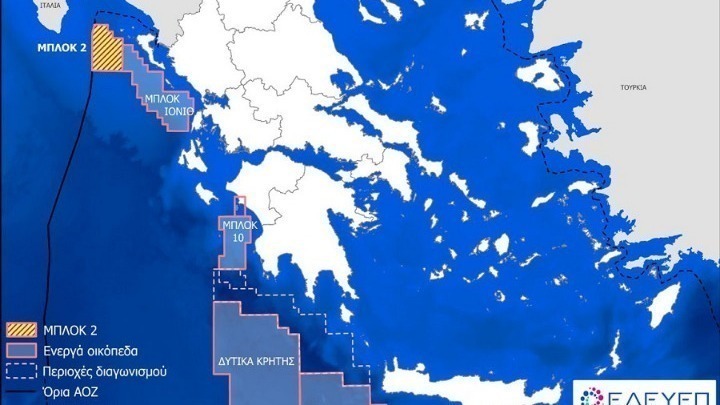
According to sources from the Hellenic Hydrocarbon and Energy Resources Management Company, which is conducting the negotiations with the Chevron-Helleniq Energy Joint Venture, the financial terms have been agreed and the discussions are now focused on the legal part of the contracts.
It is recalled that the two companies have been declared as preferred investors for the 4 areas (South of the Peloponnese, A2, “South of Crete 1” and “South of Crete 2” and the schedule of actions provides, after the completion of the negotiation and the signing of the contracts, an audit by the Court of Auditors and submission to Parliament for ratification.
Developments in the Ionian Sea are more advanced with the signing last week of the agreement – a milestone for ExxonMobil’s entry into the concession of “block 2” west of Corfu on the border with the Italian EEZ, an agreement that paves the way for the first, after 40 years, exploratory drilling in Greece.
The agreement for ExxonMobil’s entry into “block 2”” was signed in the context of the Partnership for Transatlantic Energy Cooperation (P-TEC) that took place last week in Athens. Minister of Environment and Energy Stavros Papastavrou spoke of a “historic opportunity” for Greece as, if the existence of commercially exploitable deposits is confirmed, the conditions are created for the country’s energy self-sufficiency.
Based on the agreement, ExxonMobil acquires 60% of the Joint Venture while Energean retains 30% and Helleniq Energy 10%. The next steps in this concession include, in addition to the required licensing and the extension of the exploration period that ends next March, the reassessment of seismic data from the area that have been collected in previous years and the decision to carry out exploration drilling, costing 50-100 million dollars. The “window of opportunity” for ensuring the availability of the required drilling equipment is placed at the end of 2026 and the beginning of 2027 as for that period Energean has an “option” to use the drill rig that it has already committed for its activities in Israel.
If the results of the exploratory drilling are positive, new exploratory drilling will follow to estimate the size and finally production drilling with investments placed at the level of 5 billion dollars for the construction of the pumping, processing and transportation facilities for the natural gas that may start flowing after 2030.
The initial indications are encouraging for two reasons: First, the processing of the seismic data so far “shows” that the potential resources in the “Asopos” structure of “block 2” reach 200 billion cubic meters, in a water depth of 850 meters and a total depth of 4,000 meters below sea level. And second, there is a confirmed petroleum system in Western Greece.
On the sidelines of the meeting, ExxonMobil’s vice president, responsible for international exploration activities, John Ardill, stated that the examination of data from seismic surveys is underway in the other two offshore blocks, in which the company participates jointly with Helleniq Emergy, west and southwest of Crete, in order to decide whether exploratory drilling will proceed there as well, with the decisions expected in mid-2026.
Particularly important from a geopolitical point of view were the agreements signed within the framework of P-TEC for the transmission of liquefied natural gas from the USA through the Greek system to the countries of the region up to Ukraine. This plan highlights the USA as a key supplier of the region and Greece as a key transit hub as the transmission of large quantities will be done through the Greek system. But also in cooperation with the Greek shipping industry and the fleet of Liquefied Natural Gas (LNG) carriers, which was specifically mentioned by the US Secretary of Energy Chris Wright, who participated (as did the Secretary of the Interior Doug Burgum) in P-TEC.
The prospects for the project are now expanding as, in addition to the expected increase in consumption in the region, additional needs are created by the cessation of Russian natural gas imports, gradually until the end of 2027 according to the latest EU decisions.
According to Greek market estimates, in the coming years, demand for natural gas in Central and Eastern Europe is expected to increase by 15-17 billion cubic meters per year, while another 15-16 billion is the gap that will be created by the interruption of Russian gas. Greece can cover a significant part of these quantities as the export potential from the Greek system with the upgrades that have been made and are planned to be made will reach 10 billion cubic meters. That is, one third of the additional needs of the region. Given the political support of the plan, a prerequisite for further increasing Greek exports to the region is the conclusion of trade agreements. This started on Friday with the signing of the agreement of ATLANTIC – SEE LNG TRADE (a joint venture of the AKTOR group and DEPA Commercial) for the purchase of LNG from the American Venture Global, which is among the largest LNG producers in the USA. On the same day, agreements were also signed with companies in Romania and Ukraine for the resale of the gas.
As DEPA sources pointed out, the contract with Venture Global is the first long-term contract for the purchase of liquefied natural gas in the region, while at the same time the company will be the only one in the region to have a contract for gas from a pipeline (TAP pipeline).
