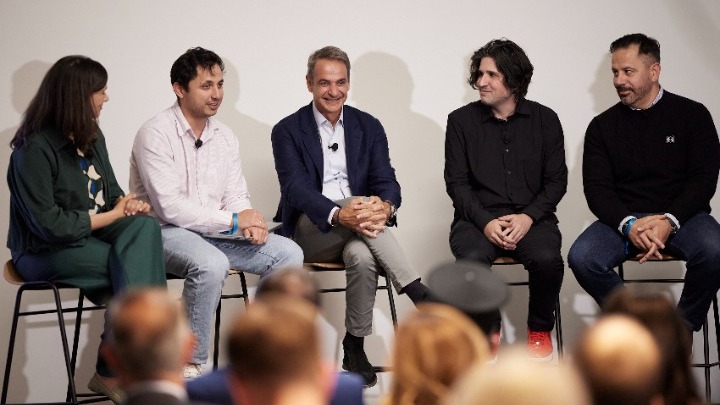
Prime Minister Kyriakos Mitsotakis participated in a conversation with Greek and Greek-American founders of artificial intelligence and high-tech companies, in the context of an event organized by Endeavor Greece titled “The Future of AI Elsewhere,” in San Francisco.
Participants in the conversation included Anastasios Angelopoulos, co-founder and CEO of Arena; Anastasis Germanidis, co-founder and co-CEO of Runway; Nicky Goulimis, co-founder and CEO of Tunic Pay; and Spiros Xanthos, founder and CEO of Resolve AI. The discussion was moderated by Andreas Stavropoulos, Partner at Threshold Ventures and Vice President of Endeavor Greece.
The Prime Minister’s remarks follow: In his opening remarks, the Prime Minister noted:
First of all, these are incredible stories. And what I did not share with the audience is that these stories resonate with me not simply because of my current job, but because I actually was a venture capitalist before I entered politics.
And at the time, I essentially created the first dedicated tech fund in the early 2000s. I mean, it was way ahead of its time and it was very, very difficult at the time to even talk about entrepreneurship and about the sort of stories that you’ve been able to tell us today.
But I think if there’s a common thread here, it’s meritocracy: it’s a sense that regardless of where you come from, what your background is, if you work hard and if you have some proper support, you can succeed. And I think this question of scholarships and giving the ability to people to actually leave Greece and acquire education and experience abroad is incredibly important.
The question that I would have for the team is twofold. First of all, for those of you who don’t have a presence in Greece, does this story of actually returning to Greece to do some of the work, maybe some of the development work in Greece, actually resonate?
I open a parenthesis here. I remember when the CEO of Pfizer, Albert Bourla, went to his board and said, “I want to do an AI big analytics center in Thessaloniki”. He was actually from Thessaloniki. So obviously he had a reason to try to convince his board. And his board went along with it. And at the time he said, “we’re going to start with 200 people”. And now they have more than 1,500 people in Thessaloniki, simply because they had access to excellent talent.
So there is a generation of people after you that is ready to look for the opportunities to start working for companies like yours and maybe then take the next step and do something on their own.
And my second question and my encouragement is to please ask you to act as mentors through Endeavor or even individually, give some of your time to these young entrepreneurs and founders in Greece.
I should point out that the work that Endeavor does in identifying high-impact companies, but also offering these services, is really invaluable. I thought I saw my wife here somewhere, but she disappeared. I should point out that I’m a personal friend of the founder of Endeavor, Linda Rottenberg. We were classmates at Harvard.
So I tried to convince her to come to Greece many, many years ago. And she was telling me, “no, no, no, we only do emerging markets”. And then my wife, Mareva, actually managed to convince her to come to Greece. So she’s, as a founder, very appropriately disappeared. As I was saying, we saw these very kind comments about her.
But again, the work that you do and the mentorship aspect of what you could do, it’s incredibly inspirational. The problem that we had some time ago is that we didn’t have enough success stories.
So, okay, I mean, what is this journey? You want to become an entrepreneur, what’s next? How are you going to raise money? Are you going to do your exit? Are you going to be happy? Are you going to become a serial entrepreneur? We did not have enough examples.
There’s nothing more inspirational than a good example and nothing more inspirational than someone who’s done it before, who’s gone through the pain. Because, you know, we’re not talking about the good side of entrepreneurship, but I want you to share with the aspiring entrepreneurs, the difficulties, the failures, the effort, the disappointments, because that’s also part of the journey.
So these are sort of my two observations that I’m interested to hear.
Referring to the initiatives the government has undertaken regarding “brain gain,” Kyriakos Mitsotakis stated: And if I may just make one quick point, we actually as a government are running – and this is not just for the tech space, it’s in general for the Greek economy – we are running tech fairs abroad and we’re bringing Greek companies abroad. And then we’re essentially asking Greeks and maybe even non-Greeks who are interested in working in Greece to actually come and join them. And it’s been an incredible success because talent is scarce these days. It’s globally scarce.
So in Greece, we have two advantages: we have people in Greece and we also have a great community outside Greece. And as we were saying before, we were never really able to bridge these two.
But you’re absolutely right. Our experience is even when the bigger companies are recruiting, a significant number of people are people who come from abroad. Because if you want to change your life, you return to Greece. I remember when we returned, when our first daughter was born in ’97, there’s always, you know, you’re changing your life. Sometimes working for a company, an established company, or even a smaller company, but not having to start on your own, gives you a safer path to return.
And invariably, I mean, most cases, people who come to Greece are -over the past years we run some surveys – have been happy with their choice to return to Greece. Because at the end of the day, if you’re someone who’s been abroad for many years and you want to return to Greece, I think two things. I mean, first of all, you need a good job, but you also need to fundamentally believe that the country is moving in the right direction.
You’re bringing your family back, you’re looking for schools, you’re looking for a place for your kids to grow up. So unless you believe that the country has actually turned the corner, and that we’re not going to go back to what we lived through over the past decade, you’re probably going to say that this is not a good choice.
When asked about efforts to establish a regulatory framework for the digital economy and the challenges involved, the Prime Minister noted: First of all, we exist within the context of the EU law, so we cannot really do our own thing. Even when it comes to social media ban, there’s only that much we can do on our own in terms of enforcing whatever ban, because at some point we may bump into the Digital Services Act and this may cause us other sorts of problems.
So we’re not independent, but we can, to a certain extent, shape the debate.
My big concern in listening to you all, and one of the reasons why I wanted to take this trip, is to educate myself better. Because if there is a constantly widening gap between what’s really happening in terms of these extremely sophisticated technologies and how policymakers appreciate it, many things could go wrong. Either we say this is too complex, we don’t want to touch it, or you could be captured by the big players who would essentially write the regulation on your behalf, or because you’re going to be scared that something catastrophic may happen, which you have good reason, you will just hit the brakes way too hard.
Do I have an answer? A clear answer? No. But what I know is that I would like to at least identify some verticals, and healthcare would be a good example in Greece. What I would like to say, “okay, I have data. What do I do with it in a way that respects privacy but can also add value to my healthcare system?”
I cannot win all battles, and it’s not my job to actually do that. But at the end of the day, I fundamentally believe, as we discussed previously, that the battle of regulation is going to be fought here in the US.
China is a different model because they are already quite centralized in terms of government control over the tech companies. They resolved this issue some years ago. But here it’s a different story.
So eventually, I think the future of AI and AI regulation is not so much going to be shaped in Europe because to a certain extent we’re technology takers. Unfortunately, it’s going to be shaped here in the US.
When asked to comment on the differences between the investment environment in Europe and the U.S. with regard to AI, Kyriakos Mitsotakis underlined: And there is, unfortunately, I mean, you have liquid capital markets. And you have another thing which we have not been able to solve in Europe, which for me would be the number one priority, is to take advantage of the single market.
You have a big market in Europe, but you still have so many regimes you have to deal with. So this idea we call it sort of the “28th regime”: set up one EU incorporation where you can actually set up in Greece and operate in Lithuania seamlessly.
As a European, this would be my number one priority because we talk about a single market in digital services. We’re big, we’re like 450 million customers. But if you want to do business in all European countries – whereas if you want to do business in the US, you can do business anywhere- it still has not happened.
Regarding his interlocutors’ suggestion to establish a direct flight between Greece and San Francisco, the Prime Minister stated: Speaking of flights, 10 years ago we had practically no nonstop flights from the US to Athens. This summer, we have 130 flights a week from the US into Athens. Surprisingly, and again, next year, there is a nonstop flight from Seattle to Greece. Just in the summer, but still, that’s how they start, and then they realize that they can actually fill the planes for longer and longer periods.
So it’s a good point. We will talk to the big carriers, especially United Airlines. And I think there’s a convincing case to be made for a nonstop flight. I’ll be happy to be on it.
