The government of François Bayrou in France failed to secure a vote of confidence from the National Assembly, with the eurozone’s second-largest economy now sinking into an even deeper political crisis.
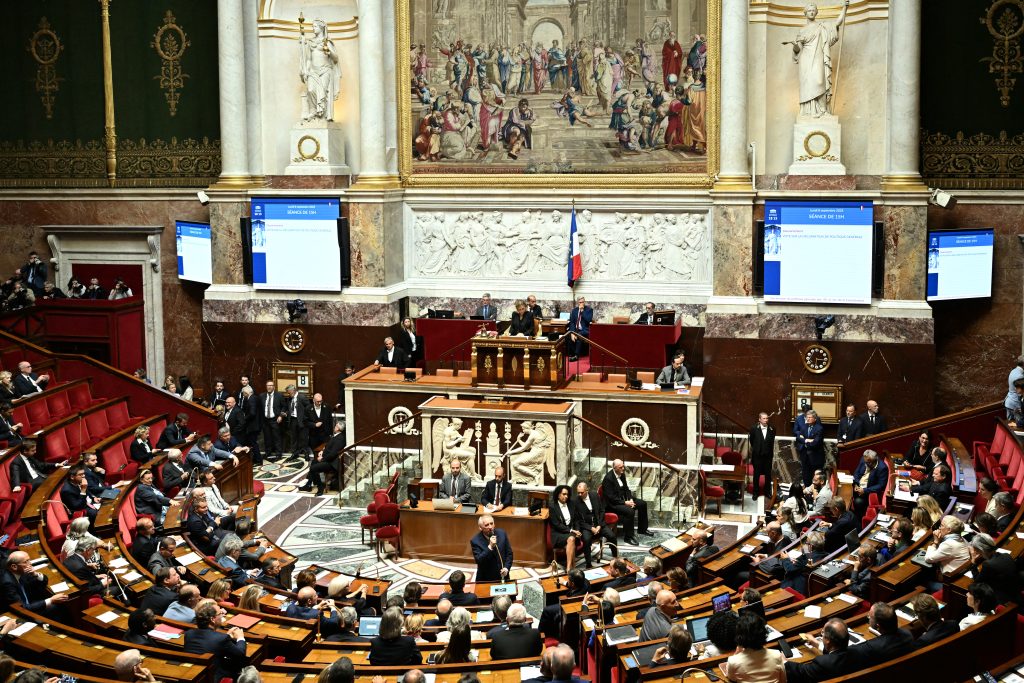
François Bayrou — despite his dramatic pleas — lost the vote of confidence in the face of the harsh fiscal measures he had announced to tackle the debt crisis.
He will submit his resignation to President Emmanuel Macron no later than Tuesday morning, according to government sources. Specifically, 364 deputies voted “against” and 194 “for,” while 25 abstained.
According to an Élysée statement, Macron will appoint a new prime minister in the coming days.
In essence, the recent developments are the chronicle of a foretold fall, since it was considered certain that Bayrou would not gather the necessary support. Nevertheless, he delivered a rather dramatic speech beforehand, saying among other things that “the country has not had balanced budgets for 50 years” and raising the issue of responsibility toward future generations, stressing that “at this stage one can bring down the government, but not ignore reality.”
It is recalled that in the previous confidence vote Michel Barnier had received only 331 “against” votes compared with the 364 “against” that Bayrou received.
Macron’s options
He can choose a new prime minister. Picking a name that will not be immediately rejected by one of the major parliamentary groupings may not be an easy task, and last year that process took Macron several weeks. In the meantime, Bayrou will likely remain as caretaker prime minister until a successor is appointed.
Macron could also call new parliamentary elections. That would shake up the current composition, but could lead to an even more decisive victory for Marine Le Pen.
Macron also has the option of calling presidential elections, in which he could not stand as a candidate since his second term ends in 2027. Some parliamentary groups have urged him to follow this path, but he has repeatedly ruled out resigning.
What applies to Le Pen
Le Pen will face the Court of Appeal over irregular employment and the misappropriation of EU public funds on January 13 next year.
Moreover, the Court of Appeal has promised the far-right politician that it will deliver its verdict in the summer of 2026 so that, if acquitted, she would be able to run in the presidential election.
Until then, Le Pen does not have the right to stand in parliamentary elections.
Earlier, she called on Emmanuel Macron to resign, noting that early parliamentary elections “are not an option but an obligation” for Macron.
The opposition demands early elections
The political temperature in France is rising and pressure on Emmanuel Macron is mounting as he is called upon to find a middle ground. At the heart of the confrontation are the country’s fragile public finances, with France at risk of entering a double crisis: political paralysis at the top and mounting unrest. Tomorrow will be crucial for the country and for Europe.
Boris Valo, president of the Socialist parliamentary group, noted that “we propose another political path that is not Macron’s policy which has led us into a dead end. We propose a new method to demonstrate confidence in Parliament, which has the ability to vote on each measure separately on the basis of our own proposals if we are called to govern.”
What Bayrou argued before the vote
Earlier, Prime Minister Bayrou spoke of a “trial of truth” about the urgent need to reduce public debt in his speech.
“This trial of truth as head of government (…) is something I wanted,” Bayrou told the National Assembly, arguing that the country’s survival is “at stake” because of its “over-indebtedness” (114% of GDP).
“Our country works, believes it is getting richer, and every year it becomes poorer. It is a silent, underground, invisible and unbearable hemorrhage,” he said in a speech that was interrupted by insults shouted by MPs from opposition parties.
“You have the power to overturn the government, but you do not have the power to erase reality,” Bayrou warned, comparing “subjugation to debt” with “subjugation to military violence,” depriving people of their freedoms.
“I speak to you literally taking our principles, principles set out in Article 27 of the Constitution: ‘The right to vote of members of Parliament is personal,’” Bayrou said. “This means that, in principle, slogans have no place here. What has a place here is the personal conscience of each member of the nation’s parliament,” Bayrou emphasized.
The French Socialist Party said it was ready to govern if President Macron asked them to, said Boris Valo, president of the parliamentary group.
Μετάφραση ρεπορτάζ της ΕΡΤ
